Quote
"Information is not a substance or concrete entity but rather a relationship between sets or ensembles of structured variety."
I
Information"In 2007, for the first time ever, more information was generated in one year than had been produced in the entire previous five thousand years - the period since the invention of writing."
Information is an abstract concept that refers to something which has the power to inform. At the most fundamental level, it pertains to the interpretation of that which may be sensed, or their abstractions. Any natural process that is not completely random and any observable pattern in any medium can be said to convey some amount of information. Whereas digital signals and other data use discrete
"Information is not a substance or concrete entity but rather a relationship between sets or ensembles of structured variety."
"Do not seek for information of which you cannot make use."
"Information is a name for the content of what is exchanged with the outer world as we adjust to it, and make our adjustment felt upon it. The process of receiving and of using information is the process of our adjusting to the contingencies of the outer environment, and of our living effectively within that environment. The needs and the complexity of modern life make greater demands on this process of information than ever before, and our press, our museums, our scientific laboratories, our universities, our libraries and textbooks, are obliged to meet the needs of this process or fail in their purpose. To live effectively is to live with adequate information. Thus, communication and control belong to the essence of mans inner life, even as they belong to his life in society."
"As I understand the theory of period information doubling, this states that if we take one period of human information as being the time between the invention of the first hand axe, say around 50,000 BC and 1 AD, then this is one period of human information and we can measure it by how many human inventions we came up during that time. Then we see how long it takes for us to have twice as many inventions. This means that human information has doubled. As it turns out, after the first 50,000-year period, the second period is about 1500 years, say around the time of the Renaissance. By then we have twice as much information. To double again, human information took a couple of hundred years. The period speeds up—between 1960 and 1970, human information doubled. As I understand it, at the last count human information was doubling around every 18 months. Further to this, there is a point sometime around 2015 where human information is doubling every thousandth of a second. This means that in each thousandth of a second we will have accumulated more information than we have in the entire previous history of the world. At this point I believe that all bets are off. I cannot imagine the kind of culture that might exist after such a flashpoint of knowledge. I believe that our culture would probably move into a completely different state, would move past the boiling point, from a fluid culture to a culture of steam."
"What information consumes is rather obvious: it consumes the attention of its recipients. Hence a wealth of information creates a poverty of attention, and a need to allocate that attention efficiently among the overabundance of information sources that might consume it."
"Wisdom is dead. Long live information."
"In the life of the mass-order, the culture of the generality tends to conform to the demands of the average human being. Spirituality decays through being diffused among the masses when knowledge is impoverished in every possible way by rationalisation until it becomes accessible to the crude understanding of all."
"I say this to you because we Spaniards are a forgetful people, because we are used to living for the moment, because we do not look back, because we do not know how to see the chain of heroes, because we do not contemplate the sum of sacrifices."
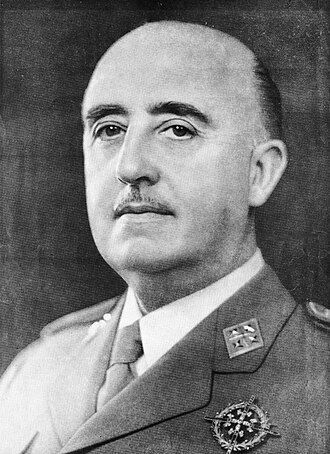 Francisco Franco
"Sharon Tate was my best friend. Once, we were roommates. She introduced me to my husband. She was the godmother to my baby daughter who is named for her. In the six years time that I knew her, she never said an unkind word about anyone."
"Long time to see. (VS: Tapion)"
"Most mathematicians prove what they can, von Neumann proves what he wants." Once in a discussion about the rapid growth of mathematics in modern times, von Neumann was heard to remark that whereas thirty years ago a mathematician could grasp all of mathematics, that is impossible today. Someone asked him: "What percentage of all mathematics might a person aspire to understand today?" Von Neumann went into one of his five-second thinking trances, and said: "About 28 percent."
 John von Neumann
"Children must be free to think in all directions irrespective of the peculiar ideas of parents who often seal their childrens minds with preconceived prejudices and false concepts of past generations. Unless we are very careful, very careful indeed, and very conscientious, there is still great danger that our children may turn out to be the same kind of people we are."