SHAWORDS

Perhaps nowhere does one find a better example of the value of histori — Pierre de Fermat

"Perhaps nowhere does one find a better example of the value of historical knowledge for mathematicians than in the case of Fermat, for it is safe to say that, had he not been intimately acquainted with the geometry of Apollonius and Viéte, he would not have invented analytic geometry."
Pierre de Fermat
Pierre de Fermat
Pierre de Fermat
author14 quotes

Pierre de Fermat was a French magistrate, polymath, and above all, a mathematician who is given credit for early developments that led to infinitesimal calculus, including his technique of adequality. In particular, he is recognized for his discovery of an original method of finding the greatest and the smallest ordinates of curved lines, which is analogous to that of differential calculus, then u

More by Pierre de Fermat

View all →
Quote
"Fermat knew that under reflection light takes the path requiring least time and, convinced that nature does indeed act simply and economically, affirmed in letters of 1657 and 1662 his Principle of Least Time, which states that light always takes the path requiring least time. He had doubted the correctness of the law of refraction of light but when he found in 1661 that he could deduce it from his Principle, he not only resolved his doubts about the law but felt all the more certain that his Principle was correct. ...Huygens, who had at first objected to Fermats Principle, showed that it does hold for the propagation of light in media with variable indices of refraction. Even Newtons first law of motion, which states that the straight line or shortest distance is the natural motion of a body, showed natures desire to economize. These examples suggested that there might be a more general principle. The search for such a principle was undertaken by Maupertuis."
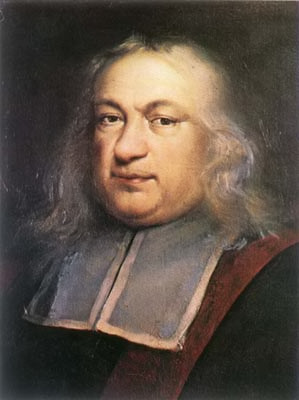
Pierre de FermatPierre de Fermat
Quote
"Fermats Last Theorem is to the effect that no integral values of x, y, z can be found to satisfy the equation xn+yn=zn if n is an integer greater than 2. ...It is possible that Fermat made some... erroneous supposition, though it is perhaps more probable that he discovered a rigorous demonstration. At any rate he asserts definitely that he had a valid proof—demonstratio mirabilis sane—and the fact that no theorem on the subject which he stated he had proved has been subsequently shown to be false must weigh strongly in his favour; the more so because in making the one incorrect statement in his writings (namely, that about binary powers) he added that he could not obtain a satisfactory demonstration of it. … it took more than a century before some of the simpler results which Fermat had enunciated were proved, and thus it is not surprising that a proof of the theorem which he succeeded in establishing only towards the close of his life should involve great difficulties. ...I venture however to add my private suspicion that continued fractions played a not unimportant part in his researches, and as strengthening this conjecture I may note that some of his more recondite results—such as the theorem that a prime of the form 4n+1 is expressible as the sum of two squares— may be established with comparative ease by properties of such fractions."
Pierre de FermatPierre de Fermat
Quote
"This great geometrician expresses by the character E the increment of the abscissa; and considering only the first power of this increment, he determines exactly as we do by differential calculus the subtangents of the curves, their points of inflection, the maxima and minima of their ordinates, and in general those of rational functions. We see likewise by his beautiful solution of the problem of the refraction of light inserted in the Collection of the Letters of Descartes that he knows how to extend his methods to irrational functions in freeing them from irrationalities by the elevation of the roots to powers. Fermat should be regarded, then, as the true discoverer of Differential Calculus. Newton has since rendered this calculus more analytical in his Method of Fluxions, and simplified and generalized the processes by his beautiful theorem of the binomial. Finally, about the same time Leibnitz has enriched differential calculus by a notation which, by indicating the passage from the finite to the infinitely small, adds to the advantage of expressing the general results of calculus, that of giving the first approximate values of the differences and of the sums of the quantities; this notation is adapted of itself to the calculus of partial differentials."
Pierre de FermatPierre de Fermat
Quote
"Fermat had recourse to the principle of the economy of nature. Heron and Olympiodorus had pointed out in antiquity that, in reflection, light followed the shortest possible path, thus accounting for the equality of angles. During the medieval period Alhazen and Grosseteste had suggested that in refraction some such principle was also operating, but they could not discover the law. Fermat, however, not only knew (through Descartes) the law of refraction, but he also invented a procedure—equivalent to the differential calculus—for maximizing and minimizing a function of a single variable. ...Fermat applied his method ...and discovered, to his delight, that the result led to precisely the law which Descartes had enunciated. But although the law is the same, it will be noted that the hypothesis contradicts that of Descartes. Fermat assumed that the speed of light in water to be less than that in air; Descartes explanation implied the opposite."
Pierre de FermatPierre de Fermat
Quote
"There is scarcely any one who states purely arithmetical questions, scarcely any who understands them. Is this not because arithmetic has been treated up to this time geometrically rather than arithmetically? This certainly is indicated by many works ancient and modern. Diophantus himself also indicates this. But he has freed himself from geometry a little more than others have, in that he limits his analysis to rational numbers only; nevertheless the Zetcica of Vieta, in which the methods of Diophantus are extended to continuous magnitude and therefore to geometry, witness the insufficient separation of arithmetic from geometry. Now arithmetic has a special domain of its own, the theory of numbers. This was touched upon but only to a slight degree by Euclid in his Elements, and by those who followed him it has not been sufficiently extended, unless perchance it lies hid in those books of Diophantus which the ravages of time have destroyed. Arithmeticians have now to develop or restore it. To these, that I may lead the way, I propose this theorem to be proved or problem to be solved. If they succeed in discovering the proof or solution, they will acknowledge that questions of this kind are not inferior to the more celebrated ones from geometry either for depth or difficulty or method of proof: Given any number which is not a square, there also exists an infinite number of squares such that when multiplied into the given number and unity is added to the product, the result is a square."
Pierre de FermatPierre de Fermat