Quote
"In my view all salvation for philosophy may be expected to come from Darwins theory."
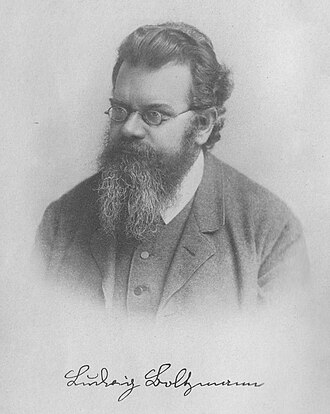 Ludwig Boltzmann
Ludwig Boltzmann
author ·
Ludwig Eduard Boltzmann was an Austrian mathematician and theoretical physicist. His greatest achievements were the development of statistical mechanics and the statistical explanation of the second law of thermodynamics. In 1877, he provided the current definition of entropy, , where Ω is the number of microstates whose energy equals the system's energy, interpreted as a measure of the statistica
"In my view all salvation for philosophy may be expected to come from Darwins theory."
Ludwig Boltzmann"The first question I answer in the affirmative, but the second belongs not so much to ordinary physics (let us call it orthophysics) as to... metaphysics."
Ludwig Boltzmann"For a long time the celebrated theory of Boscovich was the ideal of physicists. According to his theory, bodies as well as the ether are aggregates of material points, acting together with forces, which are simple functions of their distances."
Ludwig Boltzmann"Every hypothesis must derive indubitable results from mechanically well-defined assumptions by mathematically correct methods. If the results agree with a large series of facts, we must be content, even if the true nature of facts is not revealed in every respect. No one hypothesis has hitherto attained this last end, the Theory of Gases not excepted."
Ludwig Boltzmann"But this theory agrees in so many respects with the facts, that we can hardly doubt that in es certain entities, the number and size of which can roughly be determined, fly about pell-mell. Can it be seriously expected that they will behave exactly as aggregates of Newtonian centres of force, or as the rigid bodies of our Mechanics? And how awkward is the human mind in divining the nature of things, when forsaken by the analogy of what we see and touch directly?"
Ludwig Boltzmann"The following assumptions, while not professing to explain the mysteries... nevertheless show that it is possible to explain the spectra of gases while ascribing 5 degrees of freedom to the molecules, and without departing from Boscovichs standpoint."
Ludwig Boltzmann"These transverse vibrations are not produced (as in the older theories of light) by simple atomic vibrations, but their pitch depends on the shape of the hollow space which the molecule forms in the ether, just as Hertzian waves are not caused by vibrations of the ponderable matter of the brass balls, the form of which only determines the pitch."
Ludwig Boltzmann"Let the molecules of certain es behave as rigid bodies. The molecules of the gas and of the enclosing vessel move through the ether without loss of energy as rigid bodies, or as Lord Kelvins vortex rings move through a frictionless liquid in ordinary hydrodynamics. If we were to take a vessel filled with one gram of gas kept during an infinitely long time always at 0° C. and containing always the same portion of ether, every atom of ether and every atom of our gas molecules would reach the same average . If then we were to raise the temperature to 1° C and to wait till every ponderable and every ether atom was in , the total energy would be augmented by what we may call the ideal specific heat."
Ludwig Boltzmann"The possibility of the transference of energy being so gradual cannot be denied, if we also attribute to the ether so little friction that the Earth is not sensibly retarded by moving through it for many hundreds of years."
Ludwig Boltzmann"If the ether be an external medium which flows freely through the gas, we might find a difficulty in explaining how it is that the source of radiant heat seems to be in the energy of the gas itself. But I still think it possible that the source of energy of the electric vibrations caused by the impact of two gas molecules in the surrounding ether, may be in the progressive and rotatory energy of the molecule. If the electric states of two molecules differ in their motions of approach and separation, the energy of progressive motion may be transformed into electric energy."
Ludwig Boltzmann"I pointed out in the second part of my paper... that my Minimum Theorem, as well as the so-called , are only theorems of probability. The Second Law can never be proved mathematically by means of the equations of dynamics alone."
Ludwig Boltzmann"I propose to answer two questions:— (1) Is the Theory of Gases a true physical theory as valuable as any other physical theory? (2) What can we demand from any physical theory?"
Ludwig Boltzmann