Quote
"Is that never before in the history of the world have so many people been able to learn about so many other people’s lives, products and ideas."
 Globalization
Globalization
Globalization
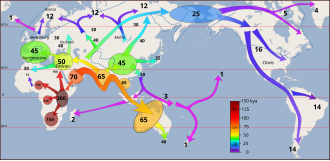
Globalization is the process of increasing interdependence and integration among the economies, markets, societies, and cultures of different countries worldwide. It can be attributed to a series of factors, including the reduction of barriers to international trade, the liberalization of capital movements, the development of transportation infrastructure, and the advancement of information and co
"Is that never before in the history of the world have so many people been able to learn about so many other people’s lives, products and ideas."
Globalization"Globalization is not in itself a folly: It has enriched the world scientifically and culturally and benefited many people economically as well."
Globalization"It has been said that arguing against globalization is like arguing against the laws of gravity."
Globalization"Low labour cost, along with flexibility in labour use, has become a key source of competitive advantage for firms. As external competition intensifies, the domestic industry has come under great pressure to restructure itself, to become more competitive and to adopt flexible policies with regard to production and labour. With a view to increasing global competitiveness, investors are moving more towards countries that either have low labour costs, or are shifting to informal employment arrangements. These changes create an entirely different political-economic environment for workers around the world. Greater international mobility of capital relative to labour puts workers from a given location at an immediate disadvantage, both in terms of bargaining power with the owners of capital (whose threat to move gains greater credibility) and with respect to the State. Thus the removal of domestic entry barriers and movement of capital to areas of cheap labour have caused intensification of domestic competition in many developing countries— especially those with surplus labour supply and those where labour is a major factor of production. This has been accentuated by potential investors citing the lack of flexibility in hiring and laying off workers as a concern, while targeting a developing country in which to invest. [...] Optimism with regard to labour as an agency of social progress has been replaced by pessimism that sees little prospect of workers acting on their own behalf."
Globalization"As recently as 2005, Britain’s centrist prime minister Tony Blair could declare that to argue about globalization made as much sense as arguing about whether autumn should follow summer. By 2020, both globalization and the seasons were very much in question. The economy had morphed from being the answer to being the question. The obvious retort to “It’s the economy, stupid,” was “Whose economy?” or “Which economy?” or even “What’s the economy?” A series of deep crises beginning in Asia in the late 1990s and moving to the Atlantic financial system in 2008, the eurozone in 2010, and global commodity producers in 2014 had shaken confidence in market economics. All those crises had been overcome, but by government spending and central bank interventions that drove a coach and horses through firmly held precepts about “small government” and “independent” central banks. And who benefited? Whereas profits were private, losses were socialized. The crises had been brought on by speculation. The scale of the interventions necessary to stabilize them had been historic. Yet the wealth of the global elite continued to expand. Who could be surprised, it was now commonplace to ask, if surging inequality led to populist disruption? What many Brexit and Trump voters wanted was “their” national economy back."
Globalization"Simplifying a great deal, one could argue that postmodernist discourses appeal primarily to the winners in the processes of globalization and fundamentalist discourses to the losers."
Globalization