Quote
"Be the change that you wish to see in the world."
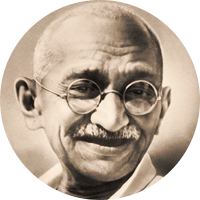 Mahatma Gandhi
thinker · 1869–1948
Mohandas Karamchand Gandhi was an Indian lawyer, anti-colonial nationalist, and political ethicist who employed nonviolent resistance.
"Be the change that you wish to see in the world."
Mahatma Gandhi"Why, of all places in Johannesburg, the Indian location should be chosen for dumping down all kaffirs of the town, passes my comprehension. Of course, under my suggestion, the Town Council must withdraw the Kaffirs from the Location. About this mixing of the Kaffirs with the Indians I must confess I feel most strongly. I think it is very unfair to the Indian population, and it is an undue tax on even the proverbial patience of my countrymen."
Mahatma Gandhi"In this instance of the fire-arms, the Asiatic has been most improperly bracketed with the native. The British Indian does not need any such restrictions as are imposed by the Bill on the natives regarding the carrying of fire-arms. The prominent race can remain so by preventing the native from arming himself. Is there a slightest vestige of justification for so preventing the British Indian?"
Mahatma Gandhi"Kaffirs are as a rule uncivilised—the convicts even more so. They are troublesome, very dirty and live almost like animals."
Mahatma Gandhi"Leo Tolstoys life has been devoted to replacing the method of violence for removing tyranny or securing reform by the method of nonresistance to evil. He would meet hatred expressed in violence by love expressed in selfsuffering. He admits of no exception to whittle down this great and divine law of love. He applies it to all the problems that trouble mankind."
Mahatma Gandhi"You say that the magistrates decision is unsatisfactory because it would enable a person, however unclean, to travel by a tram, and that even the Kaffirs would be able to do so. But the magistrates decision is quite different. The Court declared that the Kaffirs have no legal right to travel by tram. And according to tram regulations, those in an unclean dress or in a drunken state are prohibited from boarding a tram. Thanks to the Courts decision, only clean Indians or coloured people other than Kaffirs, can now travel in the trams."
Mahatma Gandhi"The Indians do not regret that capable natives can exercise the franchise. They would regret if it were otherwise. They, however, assert that they too, if capable, should have the right. You, in your wisdom, would not allow the Indian or the native the precious privilege under any circumstances, because they have a dark skin."
Mahatma Gandhi"A general belief seems to prevail in the colony that the Indians are little better, if at all, than the savages or natives of Africa. Even the children are taught to believe in that manner, with the result that the Indian is being dragged down to the position of a raw Kafir."
Mahatma Gandhi"Ours is one continual struggle against a degradation sought to be inflicted upon us by the Europeans, who desire to degrade us to the level of the raw Kaffir whose occupation is hunting, and whose sole ambition is to collect a certain number of cattle to buy a wife with and, then, pass his life in indolence and nakedness."
Mahatma Gandhi"[I]t is not true that we shall necessarily progress if our political conditions undergo a change, irrespectively of the manner in which it is brought about. If the means employed are impure, the change will not be in the direction of progress but very likely in the opposite."
Mahatma Gandhi"We are our own slaves, not of the British. This should be engraved on our minds. The whites cannot remain if we do not want them. If the idea is to drive them out with firearms, let every Indian consider what precious little profit Europe has found in these."
Mahatma Gandhi"One thing we have endeavoured to observe most scrupulously, namely, never to depart from the strictest facts and, in dealing with the difficult questions that have arisen during the year, we hope that we have used the utmost moderation possible under the circumstances. Our duty is very simple and plain. We want to serve the community, and in our own humble way to serve the Empire. We believe in the righteousness of the cause, which it is our privilege to espouse. We have an abiding faith in the mercy of the Almighty God, and we have firm faith in the British Constitution. That being so, we should fail in our duty if we wrote anything with a view to hurt. Facts we would always place before our readers, whether they are palatable or not, and it is by placing them constantly before the public in their nakedness that the misunderstanding between the two communities in South Africa can be removed."
Mahatma Gandhi