Quote
"Strength is the outcome of need; security sets a premium on feebleness."
T
The Time Machine"There are really four dimensions, three which we call the three planes of Space, and a fourth, Time. There is, however, a tendency to draw an unreal distinction between the former three dimensions and the latter, because it happens that our consciousness moves intermittently in one direction along the latter from the beginning to the end of our lives. ...Really this is what is meant by the Fourth Dimension, though some people who talk about the Fourth Dimension do not know they mean it. It is only another way of looking at Time."
The Time Machine is an 1895 dystopian, post-apocalyptic, science fiction novella by H. G. Wells about a Victorian scientist known as the Time Traveller who travels to the year 802,701. The work is generally credited with the popularization of the concept of time travel by using a vehicle or device to travel purposely and selectively forward or backward through time. The term "time machine", coined
"Strength is the outcome of need; security sets a premium on feebleness."
"Are you so sure we can move freely in Space? Right and left we can go, backward and forward freely enough, and men always have done so. I admit we move freely in two dimensions. But now about up and down? Gravitation limits us there."
"Professor Simon Newcomb was expounding this to the New York Mathematical Society only a month or so ago. You know how on a flat surface, which has only two dimensions, we can represent a figure of a Three-Dimensional solid, and similarly they think that by models of three dimensions they could represent one of four—if they could master the perspective of the thing. See?"
"If I am recalling an incident very vividly I go back to the instant of its occurrence; I become absent minded, as you say. I jump back for a moment. Of course we have no means of staying back for any length of time any more than a savage or an animal has of staying six feet above the ground. But a civilized man is better off than the savage in this respect. He can go up against gravitation in a balloon, and why should we not hope that ultimately he may be able to stop or accelerate his drift along the Time Dimension; or even to turn about and travel the other way?"
"Looking at these stars suddenly dwarfed my own troubles and all the gravities of terrestrial life. I thought of their unfathomable distance, and the slow inevitable drift of their movements out of the unknown past into the unknown future."
"The thing the Time Traveler held in his hand was a glittering metallic framework, scarcely larger than a small clock, and very delicately made. There was ivory in it, and some transparent crystalline substance. ...This little affair... is only a model. It is my plan for a machine to travel through Time. You will notice that it looks singularly askew, and that there is an odd twinkling appearance about this bar, as though it was in some way unreal."
"In the life of the mass-order, the culture of the generality tends to conform to the demands of the average human being. Spirituality decays through being diffused among the masses when knowledge is impoverished in every possible way by rationalisation until it becomes accessible to the crude understanding of all."
"I say this to you because we Spaniards are a forgetful people, because we are used to living for the moment, because we do not look back, because we do not know how to see the chain of heroes, because we do not contemplate the sum of sacrifices."
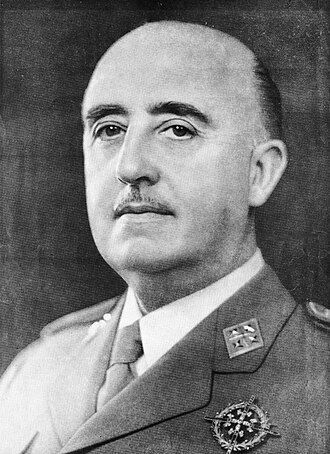 Francisco Franco
"Sharon Tate was my best friend. Once, we were roommates. She introduced me to my husband. She was the godmother to my baby daughter who is named for her. In the six years time that I knew her, she never said an unkind word about anyone."
"Long time to see. (VS: Tapion)"
"Most mathematicians prove what they can, von Neumann proves what he wants." Once in a discussion about the rapid growth of mathematics in modern times, von Neumann was heard to remark that whereas thirty years ago a mathematician could grasp all of mathematics, that is impossible today. Someone asked him: "What percentage of all mathematics might a person aspire to understand today?" Von Neumann went into one of his five-second thinking trances, and said: "About 28 percent."
 John von Neumann
"Children must be free to think in all directions irrespective of the peculiar ideas of parents who often seal their childrens minds with preconceived prejudices and false concepts of past generations. Unless we are very careful, very careful indeed, and very conscientious, there is still great danger that our children may turn out to be the same kind of people we are."