Quote
"I find it impossible to attribute with any degree of certainty any given language to any given prehistoric civilization."
 Archaeology
Archaeology
Archaeology
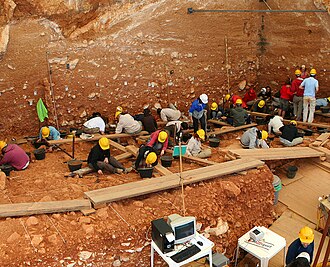
Archaeology or archeology is the study of human activity through the recovery and analysis of material culture. The archaeological record consists of artifacts, architecture, biofacts or ecofacts, sites, and cultural landscapes. Archaeology can be considered both a social science and a branch of the humanities. It is usually considered an independent academic discipline, but may also be classified
"I find it impossible to attribute with any degree of certainty any given language to any given prehistoric civilization."
Archaeology"Material culture is no more objective, apolitical, unbiased, or able to speak for itself than documents, although it has at times been treated that way."
Archaeology"Unesco conventions on antiquities have been in place since 1970. In February this year, the UN Security Council banned trade in artefacts illegally removed from Syria since 2011 and Iraq since 1990, hoping to choke off a funding source for terrorist groups. But enforcement is near impossible in both these countries amid the current turmoil. And in the destination countries, it’s up to law enforcers to establish when those objects left conflict zones. “The lack of evidence either way means that the dealer wins,” says Patty Gerstenblith, a lawyer specialising in cultural heritage at Chicago’s DePaul University College of Law. This high bar means that authorities often settle for reclaiming objects rather than pursuing cases through criminal courts – so some dealers might assess that, given the overall profits, it’s worth losing the odd artefact to the process. While we can’t second-guess the context or motives, Gerstenblith cites examples of Egyptian artefacts seized by US officials in Miami, Iraqi items in New York and Cambodian objects in Los Angeles; in each case, there were no attempts at prosecution. She suggests that less-scrupulous dealers may engage in wilful ignorance over an object’s provenance when a seller approaches them with a story. “They don’t ask a lot of questions, they think, ‘Oh fine, I have your word for it’ – and that’s sufficient to establish that the dealer didn’t know it was illegal.”"
Archaeology"It may be taken as a sign of the increasing theoretical maturity of the discipline of archaeology that it is beginning to see itself as a product of the forces of history. . . . there has been a shift from an internal understanding of archaeology as an objective and value-free practice towards a broader understanding that situates archaeology in its social and political context."
Archaeology"Unfortunately some archaeologists seem to have no eyes to see anything but what the spade digs up from the bowels of the earth, and no ears to hear anything that is not echoed from excavated ruins."
Archaeology"Archaeology as a field of study isnt just about the past, its about the present and future too. The discipline has transformative qualities. It can be used as a powerful tool to help connect communities, and can give people a real sense of place and the landscape that surrounds them."
Archaeology"In a different kind of instrumentalization, archaeology has itself been deployed as a weapon of war and structural violence, sometimes by archaeologists but often by others seeking to use it for their own aims. Targeting of archaeological sites and monuments for destruction in the context of violent conflicts, or “eliminationism” (Gonzalez-Ruibal & Hall 2015, pp. 156–57), is well attested from antiquity up to the present (Kohl 1998, Bevan 2006,Weizman 2007). Archaeological evidence has been used to justify the dispossession of people from their lands and homes, as in ongoing conflicts over the Silwan area of Jerusalem. In Silwan, excavations have revealed occupation since the Bronze Age, but the public presentation of the site by the private Israeli organization El-Ad highlights exclusively the portions of the past purportedly linked to the biblical David and other elements of Jewish history. This connection has been used to claim the area for Jewish settlement. Palestinian houses have been confiscated, and excavations have been conducted in the immediate vicinity and even underneath these properties (Abu el-Haj 2001, pp. 228–34, 258–62; Greenberg 2009; Pullan & Gwiazda 2009; de Cesari & Herzfeld 2015, pp. 181–83)."
Archaeology"An archaeologist is the best husband any woman can have; the older she gets, the more interested he is in her."
Archaeology"Linguist too frequently and too adroitly, assign languages to archaeological cultures, while archaeologists are often too quick to assign their sherds a language."
Archaeology"Archaeology helps us understand history in a different way, and is the only way that we can make sense of what happened in these islands in prehistory."
Archaeology"History is too serious to be left to historians."
Archaeology"Without archaeology we can have no proper understanding of who we are or of the places we inhabit. Every street, every field, every moor or coastline, has a human story untold by written history. Archaeology gives us the eyes to see that saga. That beauty."
Archaeology