SHAWORDS
🎭
Home

Home

Quote
"History is a strange experience. The world is quite small now; but history is large and deep. Sometimes you can go much farther by sitting in your own home and reading a book of history, than by getting onto a ship or an airplane and traveling a thousand miles. When you go to Mexico City through space, you find it a sort of cross between modern Madrid and modern Chicago, with additions of its own; but if you go to Mexico City through history, back only 500 years, you will find it as distant as though it were on another planet: inhabited by cultivated barbarians, sensitive and cruel, highly organized and still in the Copper Age, a collection of startling, of unbelievable contrasts."
G
Gilbert Highet


Quote
"The war was finished. It had lasted ten equivalent years and taken ten million lives. Thus it was neither of long duration nor of serious attrition. It hadnt any great significance; it was not intended to have. It did not prove a point, since all points had long ago been proven. What it did, perhaps, was to emphasize an aspect, sharpen a concept, underline a trend. On the whole it was a successful operation. Economically and ecologically it was of healthy effect, and who should grumble? And after wars, men go home. No, no, men start for home. Its not the same."
R
R. A. Lafferty
Quote
"Fast drivers can see no further than slow drivers, but they must look further down the road to time their reactions safely. Similarly, people with great projects afoot habitually look further and more clearly into the future than people who are mired in day-to-day concerns. These former control the future because by necessity they must project themselves into it; and the upshot is that, like ambitious settlers, they stake out larger plots and homesteads of time than the rest of us. They do not easily grow sad or old; they are seldom intimidated by the alarms and confusions of the present because they have something greater of their own, some sense of their large and coherent motion in time, to compare the present with."
R
Robert Grudin
Quote
"The Bedouin could not look for God within him: he was too sure that he was within God. He could not conceive anything which was or was not God, Who alone was great; yet there was a homeliness, an everyday-ness of this climatic Arab God, who was their eating and their fighting and their lusting, the commonest of their thoughts, their familiar resource and companion, in a way impossible to those whose God is so wistfully veiled from them by despair of their carnal unworthiness of Him and by the decorum of formal worship. Arabs felt no incongruity in bringing God into the weaknesses and appetites of their least creditable causes. He was the most familiar of their words; and indeed we lost much eloquence when making Him the shortest and ugliest of our monosyllables. This creed of the desert seemed inexpressible in words, and indeed in thought. It was easily felt as an influence, and those who went into the desert long enough to forget its open spaces and its emptiness were inevitably thrust upon God as the only refuge and rhythm of being. The Bedawi might be a nominal Sunni, or a nominal Wahabi, or anything else in the Semitic compass, and he would take it very lightly, a little in the manner of the watchmen at Zions gate who drank beer and laughed in Zion because they were Zionists. Each individual nomad had his revealed religion, not oral or traditional or expressed, but instinctive in himself; and so we got all the Semitic creeds with (in character and essence) a stress on the emptiness of the world and the fullness of God; and according to the power and opportunity of the believer was the expression of them."
T
T. E. Lawrence
Quote
"Broadly speaking, the city of the future will not bring to its center any goods not intended for use or consumption therein. At Chicago 66% of the tonnage in and out is not for home use, but for distribution to other places. In view of this fact we designed a general freight scheems for the entire city’s use, with car yards, freight depots and warehouses combined, eight miles from the city, where all trains shall unload and reload. […] I believe that such a course would be economical both for the public service companies and the city government; certainly it would prolong the life of the street paving and eliminate congestion and a constant source of dirty and disorder. Can it be doubted that the city of the future will operate its cental street system, possibly all its streets, in this manner?"
D
Daniel Burnham
Quote
"Usually, I talk with you from my office in the West Wing of the White House. But tonight theres something special to talk about, and Ive asked someone very special to join me. Nancy and I are here in the West Hall of the White House, and around us are the rooms in which we live. Its the home youve provided for us, of which we merely have temporary custody. Nancys joining me because the message this evening is not my message but ours. And we speak to you not simply as fellow citizens but as fellow parents and grandparents and as concerned neighbors. Its back-to-school time for Americas children. And while drug and alcohol abuse cuts across all generations, its especially damaging to the young people on whom our future depends."
Nancy ReaganNancy Reagan
Quote
"And so it has come to this: I, uh... am one of the lucky people in the world; I found something I always wanted to do, and I have enjoyed every single minute of it. I want to thank the gentlemen whove shared this stage with me for thirty years, Mr. Ed McMahon... Mr. Doc Severinsen... and... you people watching, I can only tell you that it has been an honor and a privilege to come into your homes all these years and entertain you—and I hope when I find something that I want to do, and I think you would like, and come back, that youll be as gracious in inviting me into your home as you have been. I bid you a very heartfelt good night."
J
Johnny Carson
Quote
"I could hardly wait for the next mornings news stories. Despite the defeat, I thought some praiseworthy mention would be made of my ten perfect innings. Then I had my first lesson in the cost of playing with the worlds greatest ball player. Quite properly the headlines screamed the news of Babes cracking the home run record. Vivid descriptions of his 28th homer clearing the grandstand roof. But no mention of me. Down at the end of the piece one line was given to the Boston pitcher. It said, "Hoyt pitched for Boston." I was to know another version of that incident in after years, again Ruths teammate. As our Yankee ball club pulled into tour cities, the sports pages would say, "Ruth and twenty-four other ball players arrived in town today." This was the price we paid playing with the big fellow—but it was worth it. Babe returned it to us ten times over, and none of us who played with him would ever trade that experience for all the headlines in the country."
B
Babe Ruth
Quote
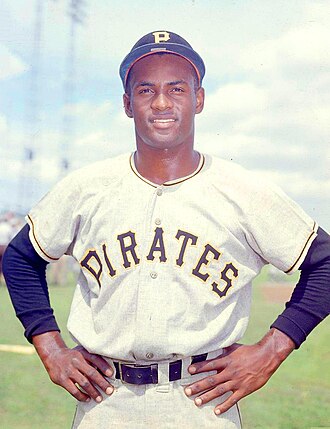
"When he was throwing to third, his throw was low enough to hit the cutoff and still get to third in the air. Coming home sometimes, he’d miss the cutoff man and try to get it all the way to the plate. Didn’t hurt him because he got it there quicker than most people. Roberto was one of the very few right fielders who could field the ball with the runner rounding first and throw behind that runner, without him taking second. He threw out quite a few guys that way."
Roberto ClementeRoberto Clemente
Quote
"For me, reading Lafferty was like looking into Chapman’s Homer. He interested me in SF again, after I had outgrown my early love for Simak and Asimov and Heinlein. What a word slinger: what a richness of idea and image, in Irish-cadenced prose! Lafferty wrote the opposite of the post-Chekhovian modern short story. Show don’t tell? The pleasure is in the telling. Rhetoric, in the grand old manner, was at the center of his game. He could go from high-faluting to just plain faluting, and back again, all in a paragraph. Like Charles Mingus, another American original, Lafferty loved the sounds he made; never satisfied with mere profundity, he was pretty, too. He was our Mingus, I think, elevating us all. And his stories always had a humanist agenda, though I understand he was a political conservative. … I believe his day is yet to come; that like Melville, Lafferty will be "discovered," and his Okla Hannali will take its rightful place as one of the three or four truly great 20th century American novels."
R
R. A. Lafferty
Quote
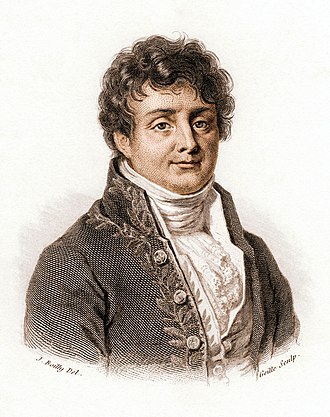
"Fourier took a prominent part at his home in promoting the Revolution. Under the French Revolution the arts and sciences seemed for a time to flourish. ...The Normal School was created in 1795, of which Fourier became at first pupil, then lecturer. His brilliant success secured him a chair in the Polytechnic School, the duties of which he afterwards quitted, along with Monge and Berthollet, to accompany Napoleon on his campaign to Egypt. Napoleon founded the Institute of Egypt, of which Fourier became secretary. In Egypt he engaged not only in scientific work, but discharged important political functions. ...In 1827 Fourier succeeded Laplace as president of the council of the Polytechnic School."
Joseph FourierJoseph Fourier