Quote
"But the best problem I ever found, I found in my local public library. I was just browsing through the section of math books and I found this one book, which was all about one particular problem -- Fermats Last Theorem."
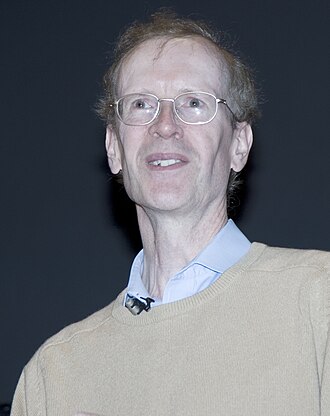 Andrew Wiles
Andrew Wiles
Andrew Wiles
Sir Andrew John Wiles is an English mathematician and a Royal Society Research Professor at the University of Oxford, specialising in number theory. He is best known for proving Fermat's Last Theorem, for which he was awarded the 2016 Abel Prize and the 2017 Copley Medal and for which he was appointed a Knight Commander of the Order of the British Empire in 2000. In 2018, Wiles was appointed the f
"But the best problem I ever found, I found in my local public library. I was just browsing through the section of math books and I found this one book, which was all about one particular problem -- Fermats Last Theorem."
Andrew Wiles"I realized that anything to do with Fermats Last Theorem generates too much interest."
Andrew Wiles"But what has made this problem special for amateurs is that theres a tiny possibility that there does exist an elegant 17th-century proof."
Andrew Wiles"Fermat couldnt possibly have had this proof."
Andrew Wiles"I loved doing problems in school. Id take them home and make up new ones of my own."
Andrew Wiles"Young children simply arent interested in Fermat. They just want to hear a story and theyre not going to let you do anything else."
Andrew Wiles"I grew up in Cambridge in England, and my love of mathematics dates from those early childhood days."
Andrew Wiles"I hope that seeing the excitement of solving this problem will make young mathematicians realize that there are lots and lots of other problems in mathematics which are going to be just as challenging in the future."
Andrew Wiles"However impenetrable it seems, if you dont try it, then you can never do it."
Andrew Wiles"Always try the problem that matters most to you."
Andrew Wiles"I know its a rare privilege, but if one can really tackle something in adult life that means that much to you, then its more rewarding than anything I can imagine."
Andrew Wiles"Perhaps I can best describe my experience of doing mathematics in terms of a journey through a dark unexplored mansion. You enter the first room of the mansion and its completely dark. You stumble around bumping into the furniture, but gradually you learn where each piece of furniture is. Finally, after six months or so, you find the light switch, you turn it on, and suddenly its all illuminated. You can see exactly where you were. Then you move into the next room and spend another six months in the dark. So each of these breakthroughs, while sometimes theyre momentary, sometimes over a period of a day or two, they are the culmination of—and couldnt exist without—the many months of stumbling around in the dark that proceed them."
Andrew Wiles